Percentage of People Who Read Articles Fully
You lot Won't Cease This Article
Why people online don't read to the terminate.

Photo by Roslan Rahman/AFP/Getty Images
I'grand going to proceed this brief, considering you're not going to stick effectually for long. I've already lost a agglomeration of you lot. For every 161 people who landed on this folio, virtually 61 of yous—38 percent—are already gone. Yous "bounced" in Web traffic jargon, meaning yous spent no time "engaging" with this page at all.
And so at present there are 100 of yous left. Nice round number. Only not for long! We're at the point in the page where you have to scroll to see more. Of the 100 of you who didn't bounciness, 5 are never going to scroll. Adieu!
OK, fine, good riddance. So nosotros're 95 at present. A friendly, intimate crowd, simply the people who want to be here. Thank you for reading, folks! I was beginning to worry about your attention span, even your intellig … expect a 2nd, where are you guys going? You're tweeting a link to this article already? You haven't even read it however! What if I proceed to advocate something truly awful, like a constitutional subpoena requiring that nosotros all type two spaces subsequently a catamenia?
Await, hold on, now yous guys are leaving too? You're going off to annotate? Come on! At that place's nothing to say still. I haven't fifty-fifty gotten to the nut graph.
I improve go on with information technology. So here'south the story: Simply a small number of you lot are reading all the way through articles on the Web. I've long suspected this, because so many smart-alecks jump in to the comments to make points that get mentioned later in the slice. But now I've got proof. I asked Josh Schwartz, a data scientist at the traffic analysis firm Chartbeat, to look at how people scroll through Slate articles. Schwartz likewise did a like analysis for other sites that apply Chartbeat and have immune the house to include their traffic in its aggregate analyses.
Schwartz's information shows that readers can't stay focused. The more I type, the more of you tune out. And it'due south not just me. It'south not just Slate . Information technology'southward everywhere online. When people land on a story, they very rarely make information technology all the mode down the page. A lot of people don't even make information technology halfway. Even more dispiriting is the relationship between scrolling and sharing. Schwartz's data suggest that lots of people are tweeting out links to manufactures they haven't fully read. If you see someone recommending a story online, y'all shouldn't assume that he has read the affair he'south sharing.
OK, we're a few hundred words into the story now. According to the data, for every 100 readers who didn't bounce up at the top, at that place are about 50 who've stuck around. Only 1-half!
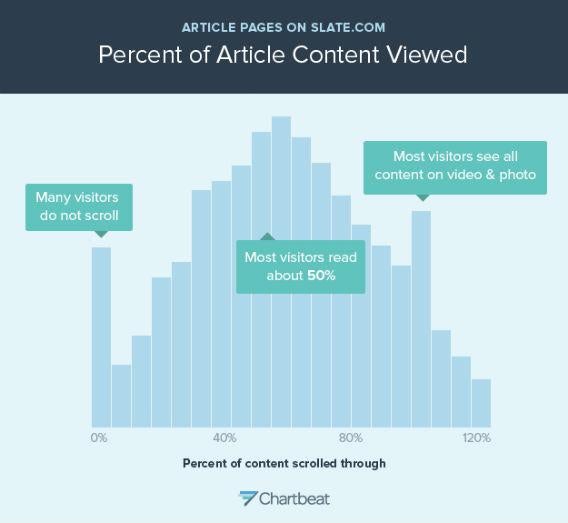
Have a expect at the following graph created by Schwartz, a histogram showing where people stopped scrolling in Slate articles. Chartbeat can rail this data considering information technology analyzes reader behavior in existent fourth dimension—every time a Spider web browser is on a Slate page, Chartbeat's software records what that browser is doing on a second-by-2nd basis, including which portion of the page the browser is currently viewing.
A typical Web commodity is about 2000 pixels long. In the graph below, each bar represents the share of readers who got to a particular depth in the story. There's a spike at 0 percent—i.due east., the very peak pixel on the page—because 5 percent of readers never scrolled deeper than that spot. (A few notes: This graph only includes people who spent any time engaging with the page at all—users who "bounced" from the page immediately after landing on it are not represented. The X axis goes beyond 100 pct to include stuff, like the comments section, that falls beneath the 2,000-pixel mark. Finally, the spike near the cease is an bibelot caused past pages containing photos and videos—on those pages, people scroll through the whole page.)
Courtesy of Chartbeat
Chartbeat's data shows that near readers scroll to virtually the 50 percent mark, or the ane,000thursday pixel, in Slate stories. That's not very far at all. I looked at a number of recent pieces to see how much you'd go out of a story if yous merely made it to the 1,000thursday pixel. Take Mario Vittone'southward piece, published this week, on the alert signs that someone might exist drowning. If the top of your browser reached only the one,000th pixel in that commodity, the bottom of your browser would be at around pixel number 1,700 (the typical browser window is 700 pixels tall). At that signal, you'd only have gotten to alert signs No. 1 and 2—y'all'd have missed the fact that people who are drowning don't wave for help, that they cannot voluntarily command their arm movements, and one other warning sign I didn't get to considering I haven't finished reading that story notwithstanding.
Or look at John Dickerson's fantastic commodity most the IRS scandal or something. If you lot only scrolled halfway through that astonishing piece, you would accept read just the first four paragraphs. Now, trust me when I say that across those four paragraphs, John fabricated some actually skillful points about whatever it is his article is about, some potent points that—without spoiling it for y'all—you lot really accept to read to believe. But of course you didn't read it because you got that IM and so you had to await at a video and so the phone rang …
The worst affair about Schwartz's graph is the big fasten at null. About 5 pct of people who land on Slate pages and are engaged with the page in some way—that is, the page is in a foreground tab on their browser and they're doing something on it, like perhaps moving the mouse pointer—never scroll at all. Now, do you know what you go on a typical Slate page if you never scroll? Bupkis. Depending on the size of the picture at the summit of the page and the peak of your browser window, you lot'll become, at virtually, the commencement sentence or ii. There'south a good run a risk you lot'll run across none of the article at all. And yet people are leaving without even starting. What's wrong with them? Why'd they fifty-fifty click on the page?
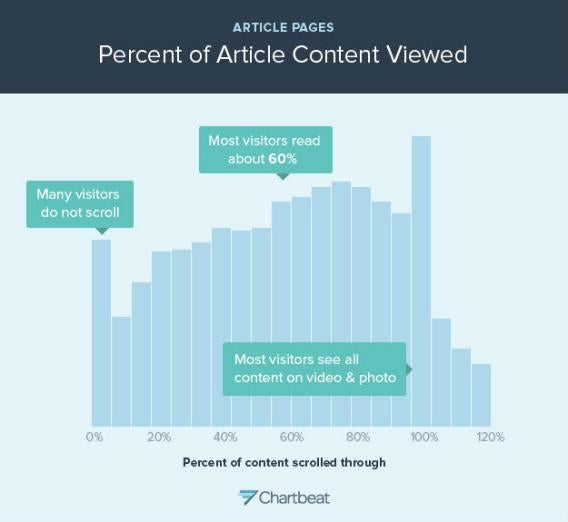
Schwarz'southward histogram for articles across lots of sites is in some ways more encouraging than the Slate data, but in other ways fifty-fifty sadder:
Courtesy of Chartbeat
On these sites, the median coil depth is slightly greater—almost people get to lx percentage of the article rather than the l percent they achieve on Slate pages. On the other hand, on these pages a higher share of people—ten per centum—never gyre. In full general, though, the story across the Spider web is similar to the story at Slate : Few people are making it to the finish, and a surprisingly large number aren't giving articles any chance at all.
Nosotros're getting deep on the page here, and so basically only my mom is still reading this. (Thanks, Mom!) But let'southward talk nigh how scroll depth relates to sharing. I asked Schwartz if he could tell me whether people who are sharing links to articles on social networks are likely to accept read the pieces they're sharing.
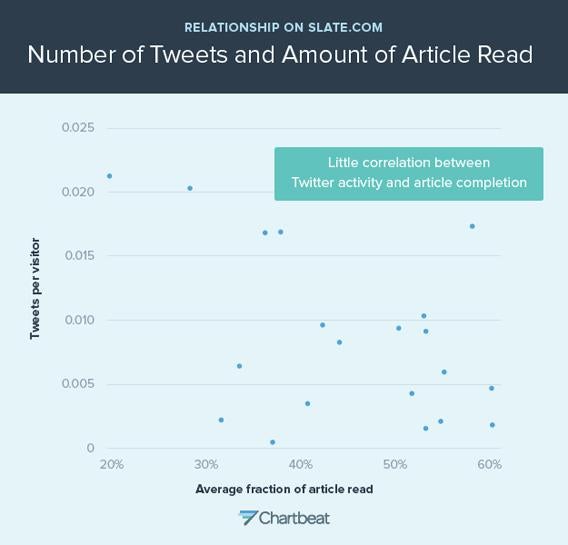
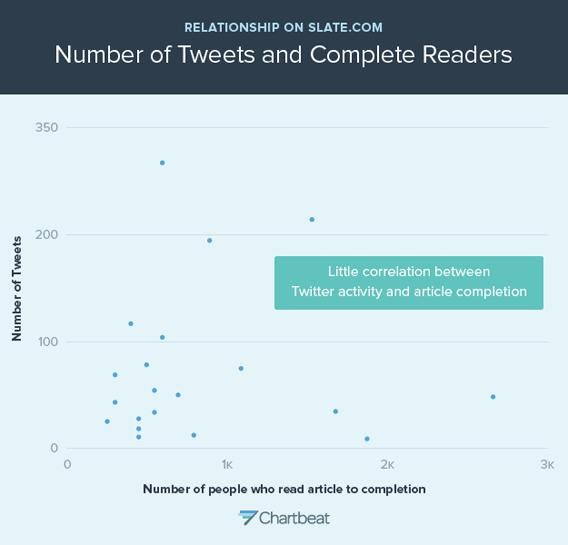
He told me that Chartbeat tin can't straight track when individual readers tweet out links, so it tin can't definitively say that people are sharing stories before they've read the whole thing. But Chartbeat can await at the overall tweets to an article, and so compare that number to how many people scrolled through the commodity. Here'south Schwartz'southward analysis of the relationship between scrolling and sharing on Slate pages:
Courtesy of Chartbeat
Courtesy of Chartbeat
And hither'due south a similar await at the human relationship betwixt scrolling and sharing beyond sites monitored by Chartbeat:
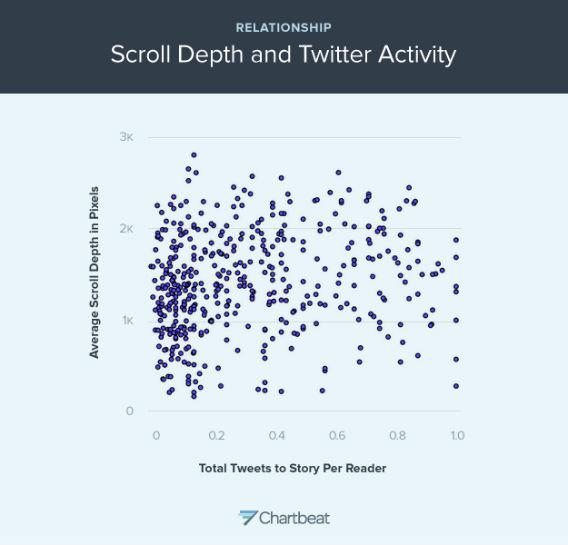
Courtesy of Chartbeat
They each show the same thing: There'south a very weak relationship between whorl depth and sharing. Both at Slate and beyond the Web, manufactures that get a lot of tweets don't necessarily go read very deeply. Manufactures that get read deeply aren't necessarily generating a lot of tweets.
As a author, all this data annoys me. Information technology may not be obvious—especially to yous guys who've already left to sentinel Arrested Development—merely I spend a lot of fourth dimension and energy writing these stories. I'chiliad even careful well-nigh the stuff at the very terminate; like correct now, I'm wondering about what I should say next, and whether I should include these ii other interesting graphs I got from Schwartz, or perhaps I should skip them because they would cause folks to tune out, and maybe it'due south time to wrap things up anyway …
But what's the point of all that? Schwartz tells me that on a typical Slate folio, only 25 percent of readers make it past the 1,600th pixel of the page, and nosotros're way beyond that now. Sure, like every other author on the Web, I want my manufactures to be widely read, which ways I want you to Like and Tweet and email this piece to everyone you know. Simply if you had any clue of doing that, yous'd accept done it already. You'd probably have done it just after reading the headline and seeing the picture at the top. Nothing I say at this bespeak matters at all.
So, what the hey, hither are a couple more than graphs, after which I promise I'll wrap things upward for the handful of folks who are nonetheless left effectually here. (What losers you are! Don't you lot have annihilation else to do?)
This heatmap shows where readers spend most of their time on Slate pages:
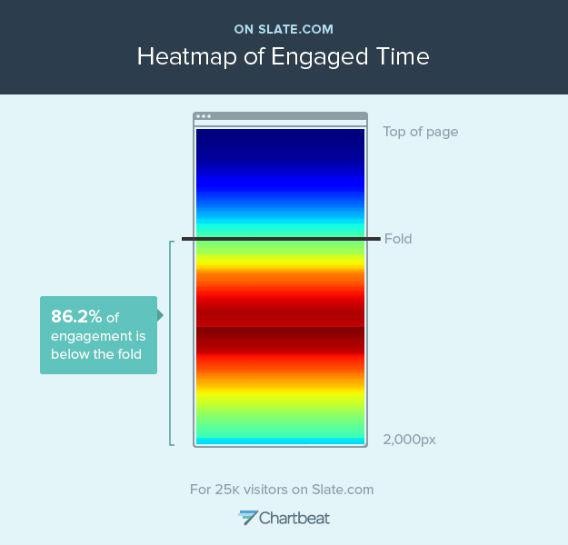
Courtesy of Chartbeat
And this one shows where people spend time beyond Chartbeat sites:
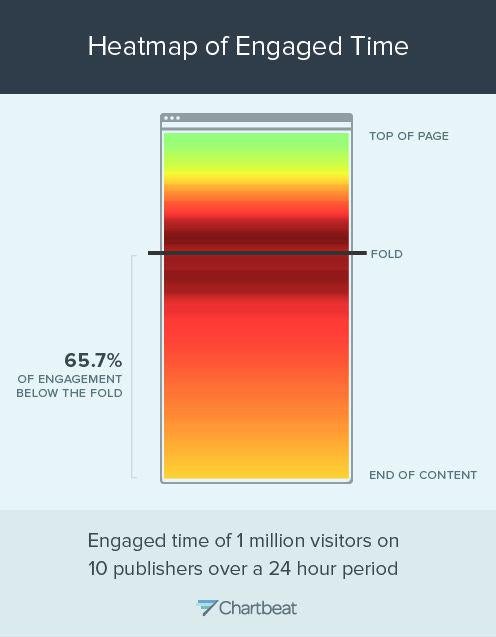
Courtesy of Chartbeat
Schwartz told me I should be very pleased with Slate 'southward map, which shows that a lot of people are moved to spend a meaning amount of their time below the initial scroll window of an article folio. On Chartbeat's aggregate data, about two-thirds of the fourth dimension people spend on a folio is "beneath the fold"; on Slate , that number is 86.2 percent. "That'southward notably good," Schwartz told me. "Nosotros generally see that college-quality content causes people to roll farther, and that'southward one of the highest below-the-fold engagement numbers I've ever seen."
Yay! Well, there's one big caveat: It'south probably Slate 's page design that'south boosting our number at that place. Since you normally have to scroll below the fold to see simply about any role of an article, Slate 's below-the-fold engagement looks really great. Merely if articles started higher upward on the page, it might not expect every bit good.
In other words: Ugh.
Finally, while I hate to see these numbers when I consider them as a writer, as a reader I'thou non surprised. I read tons of manufactures every solar day. I share dozens of links on Twitter and Facebook. Simply how many exercise I read in full? How many do I share later reading the full affair? Honestly—and I experience comfortable maxim this considering even mom's stopped reading at this bespeak—not too many. I wonder, too, if this applies to more than just the Web. With ebooks and streaming movies and Television receiver shows, it's easier than ever, now, to switch to something else. In the past year my wife and I have watched at least a 6 movies to almost the lx percent mark. There are several books on my Kindle I've never experienced past Chapter 2. Though I loved information technology and recommend it to anybody, I never did end the British version of the teen drama Skins. Battlestar Galactica, too—bailed on information technology in the eye, hoping to one solar day jump dorsum in. Volition I? Probably non.
Maybe this is just our cultural lot: We live in the age of skimming. I want to cease the whole thing, I actually practise. I wish you would, besides. Really—terminate quitting! Simply who am I kidding. I'1000 busy. Yous're busy. In that location's always something else to read, lookout man, play, or eat.
OK, this is where I'd come upward with some clever ending. But who cares? You certainly don't. Allow's only go with this: Kicker TK.
shaveryourbithes1967.blogspot.com
Source: https://slate.com/technology/2013/06/how-people-read-online-why-you-wont-finish-this-article.html
0 Response to "Percentage of People Who Read Articles Fully"
Postar um comentário